

The customer wants more of the same – they won’t change much in the rebid
Sometimes the customer won’t change much in the rebid. If you are in a market where:
- needs are not changing,
- budgets are relatively stable,
- technology isn’t making an impact on how work and processes are delivered,
- legislation and end user changes are minimal,
- Procurement formats aren’t changing
And if the customer is not experiencing any changes in their environment, competitive threats, structure, and strategy, there might not be much need for the customer to change much in their rebid.
But if you’re in one of those markets, you’re likely to be in an almost unique position.
Add to that changes to your own competitive market:
If there have been no changes during the period of your existing contract to:
- The way the service you provide can be delivered
- The number, positions, and capabilities of your competitors
- The costs or pricing strategies of your competitors
- The ambition to win or expand market share of your competitors
- Your own solutions for new bids
- What you’ve learned over the period of delivering the contract during the existing period
.. then there may be no need for you to change your own solution much either.
If that’s also the case you have bucked the worldwide trend in almost every market, sector and country. You are in a truly unique position!
In truth nearly every rebid changes the solution required to win. Because at least one of the factors above – usually many of them – have changed over the period of the contract. Yet too often incumbents don’t seem to acknowledge these changes. And, as a number of respondents to our survey of procurers said “They submit the exact same bid they submitted for the first contract without regard to spec changes”
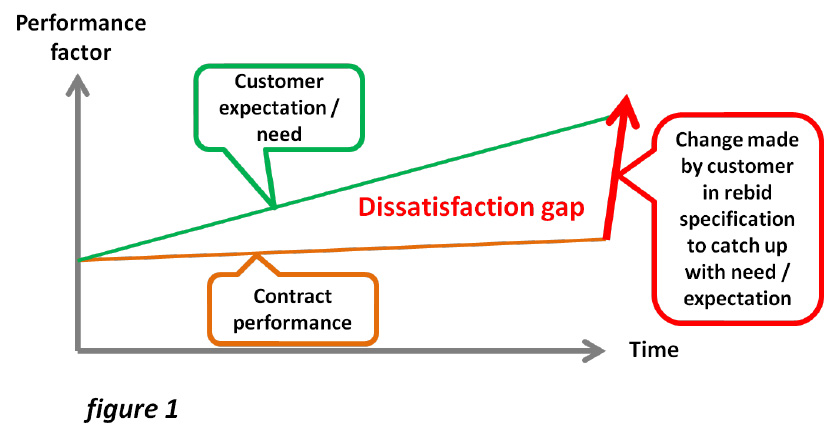
Customers do change things at the rebid. Sometimes radically (see our article and paper on Avoiding the Incumbent Credibility Gap). If you find yourself working on the assumption that not much will change (and therefore not much needs to change in your solution), you’re likely to look back later in the rebid process and realise you have been complacent.
Even if you don’t put in exactly the same bid, there’s often a temptation not to change as much as you could or should in your rebid. And any suggestions that the customer isn’t going to change the rebid will deter you from:
- Doing the preparation work needed to understand what has changed,
- Finding out what the customer is looking for in the next contract that is different to the existing one
- Determining how the customer intends to change the scope, specification, payment terms, KPIs or other aspects included in the rebid
- Preparing your own best solution to meet these changing needs.
The rebid is the chance for the customer to ‘catch up’ with all the changes in their situation and needs that have developed over the period of the existing contract, but the existing contract arrangements couldn’t deliver against. It’s also the chance for them to anticipate changes over the coming years of the next contract.
In a dynamic environment that can add up to a lot of change. And even though there will be other pressures, such as the risk of change, which could be driving against the push to adapt, reorganise, expand, contract or modernise what the customer asks for in the rebid, these will usually be overwhelmed by the needs of the organisation to keep up with its strategic position.
Your competitors will be offering new ideas and ways of delivering the contract. If you rely on the same solution you’re already delivering, you might get some benefits from the fact that it is proven, you have experience of delivering it, and there is little cost of change. But again, this is likely to be overwhelmed if the customer has the choice of a competitor’s offering that’s better, less costly and more fitted to the future than the past.
How to avoid the problem
To ensure you and the team aren’t mistakenly assuming not much will change, you need to actively seek out the drivers of change that are impacting on the customer. And talk to a range of customer contacts to get their views on what these changes are and the impact they might have on your rebid.
Don’t rely just on your direct operational customer. They may not have a strategic view of the whole organisation and the pressures (and politics) at play in the wider organisation.
And as we’ve said elsewhere, they may not have control over – or even a significant influence on – what goes into the rebid scope and specification. In some cases they may be just as wedded to the existing contract delivery and structure as you are.
After all they’ll face the task of ensuring any changes are put in place in the new contract, and the risks that go with those changes. They may be focused on compliance of the existing contract delivery. They may be very happy with how the existing contract is being delivered and think it’s suitable. They may have a vested interest in a high quality delivery solution as it makes their lives easier. They may not want to have to work with a low cost lower quality solution.
But if senior management know they need to reduce costs and are willing to sacrifice some quality to get it, that is what they will end up with.
Draw up a ‘Change List’, which lists out all the potential changes the customer is facing – and what those changes might need the contract to deliver differently to help achieve.
Challenge all aspects of your existing solution – is it really the best way to deliver these new needs? And try to dig out the assumptions that underlie the arguments being made in favour of not changing. For example, if arguments are being made that the present solution delivers the best quality – ask yourself if the best quality (at current costs) is what the customer really wants. If you could deliver a solution which delivers 5% lower quality levels but costs 20% less, would that meet their overall needs better?
Create your own new solution, based only on the new needs you’ve found about the customer’s future needs, and the latest best practices in your market – and not relying on your existing solution structure or processes as a starting point.
Too often, even when incumbents recognise change is needed they try to make those changes to the existing solution – rather than looking for a new solution that might be structurally cheaper, faster or deliver higher quality.
Creating a brand new ‘Green field’ solution avoids the temptation to tinker with the existing solution, with all its assumptions, costs, and ingrained ways of working. It may not end up being your final solution because there are lessons to learn from your experience of the existing contract.
But it means you’re not ‘trapped’ by the existing structures in place. And it will give you a fresh, new platform to test all your existing assumptions from (giving you a different perspective – rather like your competitors will benefit from).
If you take all these actions then, even if your customer doesn’t change much in your rebid, you’ll have a fresh, innovative, best practice solution to offer them.
Add your deep understanding of their needs, the evidence you can bring of your ability to deliver from your existing contract. And your ability to use your knowledge of the contract to show how your solution is better fitted to the customer’s culture, structures and requirements. Which means you should be in a very strong position to win.


