

Four reasons why your rebid preparation efforts could fail
And how to avoid them
Having an effective rebid preparation process (we call it the Recapture Plan) is one of the most important things you can do to increase your chances of winning a rebid. It means you have the time before the ITT/ RFI is published to:
- Gather the information about your existing contract and performance to use as evidence in your submission, and underpin your new solution
- Fix any issues on the existing contract
- Broaden or build better and wider relationships within your customer
- Influence the process – can you avoid the rebid, get an extension, influence the type, scope or specification of reprocurement? Can you influence the quality/ price ratio, what’s asked, scoring priorities, who’s involved in evaluation?
- If you can’t influence, you can at least gather intelligence to understand the changes the customer is likely to be asking for in the rebid in terms of scope, specification, KPIs etc
- Put together an outline solution and costs
- Put together the team for the rebid and give them the insight into the customer and contract they need to deliver a winning submission
Trying to complete these tasks when you’re responding to the PQQ or ITT is much tougher:
- You have limited time
- The team are busy: focused on costing, writing and getting the submission completed
- The customer is much less likely to make changes to the scope, spec etc they have now published
- The customer will only respond formally through the correct channels to ensure a fair competition, and in public sector bids official questions get answers sent to all bidders
- If there are issues with contract delivery, you have much less time to fix them before the customer is evaluating your submission
So why do incumbents not use the months before the OJEU / RFI to prepare for the rebid? We hear any number of reasons, but often they fall into two general categories:
- Reasons why the incumbent didn’t even try to prepare
- Reasons why the incumbent tried, but failed to prepare properly
It’s the second of these we want to cover in this article. Because if the incumbent is at least trying to prepare, there’s more likelihood they’ll be able to improve that effort through some simple actions. Persuading an incumbent that they need to prepare is a different argument.
Reasons why Rebid Preparations ‘fail’ Part 1
Limited engagement
Rebidding is a team effort. Not just by one team (e.g. the bid team), but by a range of departments across the business and the team delivering the contract itself. This is a real difference between bids and rebids. Of course, on bids the bid team will need the support of Subject Matter Experts, finance, HR etc. But on rebids they also need to have real involvement from the contract delivery team. Often over a period of several months, while that team is still busy delivering the existing contract.
A lack of engagement by other departments and the contract team in the months prior to the rebid ‘starting’ is one of the common issues we see incumbent teams face. And one of the main reasons why rebid preparation often fails to deliver all the benefits it should. Rebid teams can improve engagement by:
- Senior sponsorship. Making the case for engagement during the rebid preparation period is likely to be difficult. It’s usually more effective to make your case earlier. Look ahead at your contract rebid timetable. See when your rebids are due, and get in front of your senior exec team (or get your boss to do so) where Operations sit together with Business Development and other departmental leads. Get your CEO, divisional MD or president on board by illustrating the upcoming risks of losing the rebid (or rebids), and putting forward a clear plan of what needs to be done to avoid or reduce that risk.
Show you have a plan (more of this below) and show that it needs the engagement of all parts of the business to succeed. Getting senior sign-off for your plan and commitment of engagement will give you the confidence to get departments involved. And the ability to escalate issues if needed to managers who have made a commitment that their teams will support the rebid. If there are objections or issues raised at this senior level to your plans, at least you still have time to respond to them and rework your plan. - Contract involvement. Get in touch early with the manager responsible for the contract being rebid – ideally a couple of months prior to your plan of action starting. Make sure they understand what needs to be done to win and your plan to help them succeed. If your business has lost previous rebids, you might be able to show why and use this to advance your arguments. You could also point them to best practices in the marketplace to illustrate what can be and ‘should’ be done.
Make sure they understand the level of involvement the rebid will require from themselves and their staff. That way they can plan to be sure they’re able to give that support without impacting on contract delivery. In the past we’ve seen middle managers from a contract seconded into a bid team for a few months’ work well – to create a closer relationship and enable stronger communication and understanding of the contract (and for the secondee, how bids work). Getting involved in a monthly management meeting on the contract to show the managers within the contract what will be involved, to put a face to and build a relationship with the people who will be involved – those on the contract and those in the bid team – has also worked. - Involving other departments. You’ll also need the input of other departments during the rebid preparation project. Sitting with them to give them early notice of this will also help.
For example, finance will most likely be the source of historical data about turnover, profit and other aspects of the contract history.
HR will potentially be the source of the history and present state of staffing, staff turnover, salary costs and training history on the contract.
And both are likely to be involved in helping design, cost and resource a new solution. Ensuring these departments are prepared and ready to do the analysis needed to give you information when you need it will be a real help.
As you start your rebid preparations, you’ll be looking for any information that could reveal a useful trend or deeper understanding of the contract. You might not know what you’re looking for until you see it, so preparing people for this may give them some ideas which would help.
As you build your solution and understand what the customer’s future needs are, your enquiries are likely to be more targeted. Again, educating these other departments on how the process is likely to evolve will help them understand the context. And mean they’re more likely to positively engage vs them just seeing an apparently random set of requests for information with short turnaround times. Which often happens if things are left too late.
Reasons why Rebid Preparations ‘fail’ Part 2
No clear start to the process
Some rebid preparation processes simply fail to gain any momentum. There’s no clear plan of what needs to be done, little engagement and no sense of urgency. The actions being taken seem disconnected and can be almost invisible to many involved.
As a result, some preparation might get done, But when the rebid starts in earnest and the incumbent receives the ITT/ RFP they realise there are a whole range of things that could have been done in the preceding months, but either weren’t started or weren’t completed. The team quickly comes to the realisation they didn’t place enough priority to the rebid preparation, and the time when they thought they were getting ready has largely been wasted.
In contrast, a strong rebid preparation effort is well communicated. It has a set of clear actions. Everyone knows it is running, know what the aims and expectations of the project are and what’s expected of them. When the rebid itself starts, the incumbent team is ready. They already have a costed solution for the new contract, clear win themes and propositions for why the customer should choose them. They can focus on giving the best possible answers to the questions set and putting in the best price possible. Whilst some tweaks might be needed, the core of what needs to be done is already there, so these tweaks can be easily accommodated.
The difference between these two scenarios is often having (or in the case of failure, not having) a clear start to the process.
Creating a clear start to the rebid preparation project (and treating it as a project) means everyone involved is aware that the project is happening. It creates momentum and sets out the actions that need to be completed, by whom and by when.
One method we’ve used successfully many times is to start the project off with a Rebid Preparation Kick Off meeting.
This one day meeting brings together those from the bid and sales team who will be involved in the rebid, plus the existing contract leads and any other departments involved in the delivery of the service. The meeting has three aims:
- Inform everyone of what the rebid process will entail
- Identify what is known and not known about the contract, customer and their rebid process
- Set actions to be followed up and completed during the rebid preparation period.
The type of questions asked in the meeting to uncover what’s already known and what needs to be done cover areas such as:
- What has happened on the contract whilst we’ve been running it?
a. What has gone well
b. What has not gone well
c. What has changed
d. How are we performing now? - Who is the customer?
a. Who do we know (how well and what are their attitudes towards us)
b. Who will be involved in the rebid from the customer organisation?
c. What are their priorities for the future and the changes they want to see?
d. How can we build better relationships with them? - What is the customer’s timetable and process for the rebid?
a. When will key decisions be made?
b. What process are they likely to follow?
c. How can we input into this? - What changes are likely to be made for the next contract?
a. What are the customer’s strategies and priorities?
b. What has happened on other bids in the customer?
c. What is changing in the industry? - Who are the likely competitors?
a. Who are they
b. What strengths do they have regarding this customer / contract?
c. What is their likely approach?
The answers to these, and other questions from the meeting – and particularly from areas you DON’T have answers for, will help set out the actions you need to take to prepare for the rebid.
Set these out in the meeting, allocating them to individuals to complete and setting out a timetable for completion.
These meetings are often a ‘wake up call’ for many people. Especially those involved in the contract who either have not been focused on the rebid, don’t realise how close it really is, and perhaps didn’t have answers to some of the questions raised. It will create the involvement and engagement you need for focus and participation in your project.
Setting out a clear action plan will also give solidity to the outcome of the meeting and help you follow up on those actions.
Done well, this kick off meeting will be just the clear start you need for your rebid preparation and ensure you start with real momentum.
Reasons why Rebid Preparations ‘fail’ Part 3
The process loses momentum
Some incumbents we talk to complain that they started their rebid preparations some months before the rebid, but the process lost momentum. Actions that were set at the start weren’t completed, more important short term priorities diverted people away, changes to the customer’s needs weren’t identified, and the existing contract didn’t make the changes identified to get it into a strong position for the rebid.
The result is that despite an early spate of activity, they arrived at the rebid with too little preparation completed.
When we look at what happened, what we usually find is that they did indeed start with good intentions. But just assumed that having got people together and set several actions that this was enough. As with all projects, setting out the initial requirement then leaving things to just happen is not a recipe for success.
The first requirement to solve this is to ensure someone is responsible for maintaining momentum. That means putting someone in charge of the project who knows it’s their responsibility to get it successfully completed.
Usually that will be someone in the bid team, although it may be someone else involved in the bid. Ideally it needs to be someone with the motivation to succeed, the ‘clout’ to get people to do the things that need doing, but the ability to do this respectfully and through positive motivation. Usually, it should not be the lead of the existing contract delivery. Whilst they may have the motivation to get the project done, they’re unlikely to have a lot of experience of rebidding, or of the consequences for the rebid of not completing actions. They are also likely to be pulled away to day to day priorities on the contract itself.
For large, important new contracts you might be appointing a Capture Manager. For rebids you need a Recapture Manager.
To maintain momentum, an effective rebid preparation process also needs to involve regular reviews and updates of progress. These should be set out at the start of the process and their purpose made clear to all those involved. Actions should be set to be completed by particular dates and their progress towards completion regularly updated. We usually suggest monthly update meetings, with a conference call in the intervening fortnight for typical 6 month preparation process. For longer processes you may want to just update monthly until you are 6 months away from the rebid start. But if you do this, don’t miss a month, leaving actions ‘hanging’ for 2 months.
Each meeting and call should go through all the actions set (written out as a project plan with responsibilities, outcomes required and dates for completion against each action). Those with responsibility for each action should be required to report back on progress, together with updates on expected completion dates. If action completion dates start to drift, a separate session with them may be required to understand why. Are they being pulled onto other priorities, is the action itself presenting problems, are they not getting the input or cooperation they need?
Each review should also look for new information and updates – what new intelligence has emerged from the customer, how does this impact on plans etc.
Ideally you’ll also hold one meeting halfway through the overall project period, where you’ll take a detailed look at the progress to date and your readiness for the rebid.
This should lead to refocusing efforts and resources on the key areas identified as priorities for the final part of the project.
There tend to be four strands of work involved in a rebid preparation process:
- Understanding and reviewing the existing contract
- Building / expanding customer relationships
- Understanding what changes will be required in the new contract
- Building a new solution
Each overlaps and interacts with the other (better relationships help understanding of changes, which leads to a better new solution for instance). And whilst the main focus of effort will move from 1 through to 4 as the preparation process progresses, all will continue throughout the project period. Ensuring actions and plans for each area are in place, and proactively reviewed, updated and completed to time will ensure you maintain momentum and arrive at the rebid itself fully ready to win.
Reasons why Rebid Preparations ‘fail’ Part 4
Starting from scratch with every rebid
The rebid you’re (hopefully) preparing for now may possibly be your first rebid. But it’s unlikely to be your last. And any organisation with a portfolio of contracts will face multiple rebids, potentially each year. Most repeated processes, especially in bidding have set actions and governance processes completed for each bid. For example, bid / no bid, kick off meetings, storyboarding, review meetings.
But many businesses don’t have such a repeatable set process for rebid preparation, even though the process is largely the same each time.
Instead, the rebid lead must start from scratch each time. Persuading people the preparation is important, that time spent in preparing will be worth it and ‘selling’ the effort and process each time a rebid approaches.
If they’re not on the ball, the process doesn’t happen automatically, and they can find themselves facing a PQQ/RFI for the rebid of an existing contract with little or no preparation done.
Setting out a repeatable process for rebid preparation is relatively easy. Especially for organisations with multiple contracts delivering similar products or services to similar customers. But it does take time and effort, and sometimes a couple of failed attempts, before the process becomes engrained in the culture of the organisation as the natural and right thing to do every time.
Below are a few things you can do to make this process easier.
Know when rebids are due
In some respects, it’s easier to know when your rebids are due than it is to plan for potential new bids. You know the contracts the business has now. In most cases you know how long the contract is for, when it was won and therefore when it’s due to end. Whilst they may vary somewhat you can usually estimate how long the rebid process itself will be.
So, you can subtract this from the contract end date to get a sense of when the OJEU or equivalent will be released. You should therefore be able to plan for at least 2-3 years ahead when and how many rebids you’ll be facing. Whilst there will be variables such as extension periods for contracts, you can also take these into account in most cases.
By then estimating when the customer is likely to start their own process of thinking about and working on their preparations for the rebid (deciding on possible extensions, looking at future needs, deciding on the scope and specification for the new contract, writing the process, questions and deciding how the bids will be evaluated etc) you can work out when you should be starting your rebid preparations. This might be anywhere from 6 -18 months before the rebid ‘officially’ starts depending on the size and complexity of your contracts.
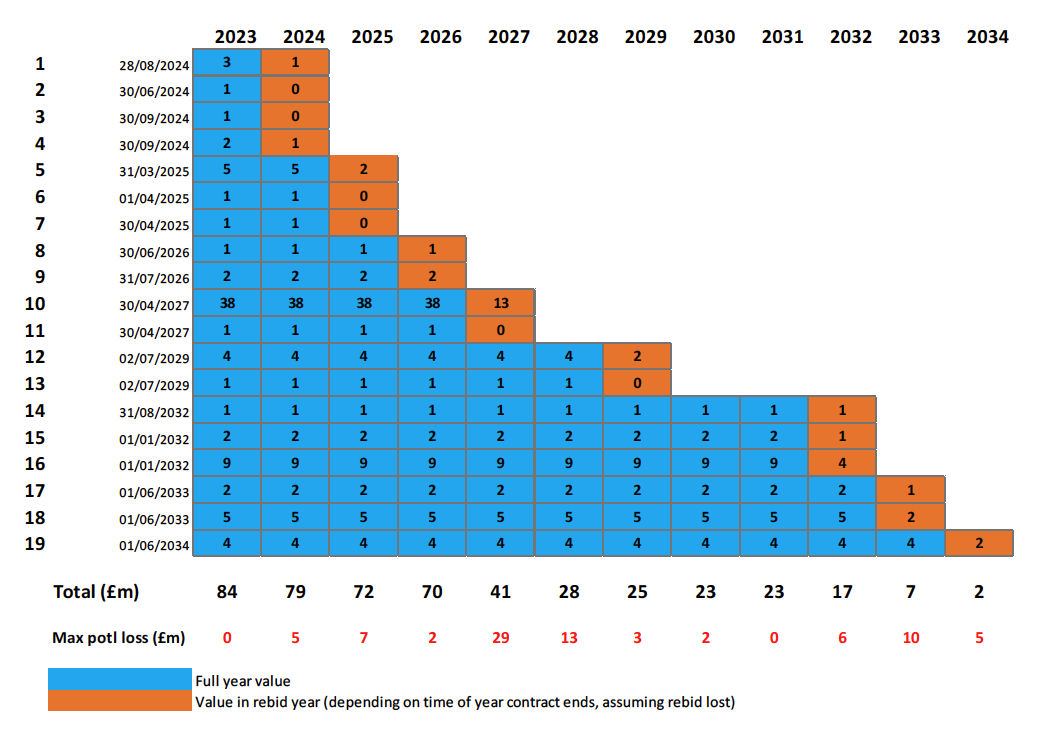
By creating this forward looking calendar (see a simple example on the next page) you can make sure your yearly budgeting and planning takes into account the work on rebid preparation you’ll need. And the resources you will require to implement the projects. It will also mean your (or your relevant senior director) can ensure colleagues in contract delivery and other relevant departments are also aware of the effort required.
Part of this planning process should also highlight the amount of turnover and profit the company would lose if these rebids were lost. Knowing this can focus the attention of even the most senior people in your business on what needs to be done to avoid these losses!
The diagram below shows an example of a fictitious organisation’s existing 19 contracts and the year they each finish. The numbers in the blue boxes are the turnover (or profit if you prefer to calculate it that way) for each contract year. The orange boxes show the turnover for the final year (the contract might end during your financial year). Across the bottom the total numbers show the turnover of the 19 contract portfolio – and how this would reduce each year if all the rebids were lost. The red figures across the bottom show how much turnover is at risk from rebids each year.
For this example, the big ‘danger’ years are 2027 and 2028. Remembering those years are when the impact of the potential losses impact. If you create a similar table for your own organisation (and we recommend you do!) the rebid preparation work for 2027 and 2028 would be happening well before those dates.
Of course, losing all your rebids is a definite worst case scenario. But it does illustrate what’s at risk. If you create a similar table for your own organisation, you could include your current rebid retention rate to give a more nuanced view.
This type of analysis can be useful to use with your senior management to get their attention on the risks rebids have for your organisation. It’s often not an analysis they’ll have had from others.
Set out a clear repeatable plan that can be used for each rebid
In the previous parts to this paper we set out what a rebid preparation process should look like and the areas to focus on. Your own process will be unique to your organisation and sector but will most likely follow a similar general outline.
Creating and communicating this process will mean people know what to expect and will have more confidence there’s a plan to follow. By adding this detail to your calendar for the year you can also see what you (and others) should be doing when. If you have multiple rebids, you can also see where the ‘pinch points’ might be for resources and plan for them.
Learn from each rebid
As you’re persuading colleagues that a rebid preparation process is needed, using examples of issues created by a lack of preparation in previous rebids will be useful. And as you start to gain the benefits of a preparation process, using these to reinforce its repeated use will help embed the process.
Review each rebid, including what happened in the rebid preparation period. Make sure colleagues see the benefits and add new elements of variations based on what worked (and what needs improving) every time you complete a rebid.
Focus on communicating with all your contract colleagues
The bid team and many ‘central’ departments will most likely be involved in multiple rebids, so the learning from each will grow.
But contract teams only face a rebid every few years for their own contract. For many of them it will be a new experience. Although they’ll be motivated to retain the contract (and their jobs – at least in your business), they will not understand the benefits of preparing for the rebid, how the process will work, or how it will mean additional work for them.
To overcome this, get one or more contract managers who have been through the process to do a joint presentation with you at any business contract managers meetings that occur in your organisation. Whilst you can cover the process, they can cover what the process was like from their perspective and how it helped. Their input with their peers is likely to add credibility and impact to your message and mean those managers with rebids coming up will be more aware of what is required and perhaps more likely to engage earlier.
Summary
There are common reasons why rebid preparation efforts fail. But by getting engagement early, creating and building momentum, and putting in place a repeatable process for rebids you can avoid these most common issues. It can take work and effort to set up, but the results will be worth it!
All the ideas we refer to in the paper are more fully described in our book The Rebid Guide, together with step by step guidance of how to put them into action on your contract and rebid. You will also find papers and articles on how to prepare for and run your rebid on our website. Read more articles or buy the Guide.
Rebidding Solutions helps incumbents win their rebids. As well as providing articles, advice and processes for rebidding we have also published the Rebid Guide which contains 60 ideas for incumbents to put into practice from day one of their contract to improve their chances of winning their rebid.
We also provide consultancy and bespoke training for incumbent companies and contracts, helping them put together the processes and actions that lead to rebid success.


