

That problem has been long forgotten. No one cares now
Few contracts go through their whole life without there being some issues. Most will be minor, or temporary. But others can be significant or long running. Perhaps the implementation wasn’t as good as it could have been. Or a particular area of delivery has been harder to meet than expected. There may have been a significant if short lived problem which was eventually resolved, but could leave the customer with doubts about your resilience or risk management.
As a bidder, or recapture manager preparing your rebid effort, you might not be familiar with what has happened throughout the contract. Especially the early years. Perhaps everything seems to be working well now.
But you shouldn’t take that for granted.
Customers can have long memories. As they prepare for the rebid they’re likely to be reviewing the original contract and looking at how delivery has lived up to the expectations they had at the time. And those you set in your original bid. If you haven’t lived up to them, there might be underlying dissatisfaction about your performance or approach.
At the same time, there may have been issues at some point in the contract that were never properly resolved. Your contract team might think the issue has gone away. Perhaps because the customer has stopped asking about it. Don’t assume that means they’re happy. They might just have given up asking because they have had no effective response. And don’t assume the customer won’t have any issues in mind when they’re evaluating your response. No matter how objective marking is supposed to be in the rebid, those evaluating responses can’t help but bring their experience to what they read.
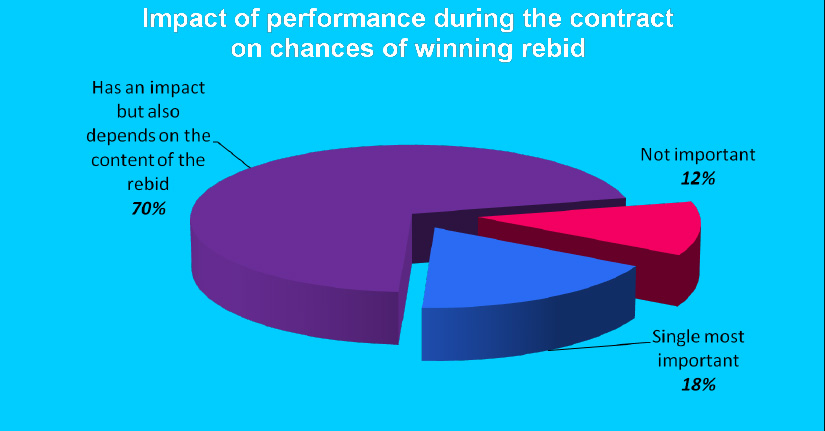
As our survey of procurers revealed, 88% of procurers see contract performance as having some influence on their decision of who wins a rebid.
Going in to your preparation for the rebid, creation of a new solution, and writing of your rebid submission without investigating and properly challenging your team to uncover, remember and review any issues during the contract could leave you in a difficult or embarrassing position in the rebid.
More importantly not addressing any issues the customer remembers could create real dissonance in the mind of the customer when they read your submission.
They could think you’re trying to gloss over the issue. Or perhaps that you don’t see it as a problem. Either way it won’t give them confidence that the problem won’t occur again.
You won’t gain many points talking about your effective risk management approach if the customer has experienced the opposite.
And talking about your commitment to continuous improvement won’t give the customer much confidence if you’ve not improved contract performance over the past 3-5 years. Especially if you also talked about the same commitment in your original bid.
These sort of issues and mistakes are likely to make you look complacent in the eyes of the customer.
How to avoid the problem
As a bidder or recapture manager, you need to have a clear understanding of what’s happened on the contract to date.
Knowing all the good things that have been delivered gives you powerful evidence for why you should be chosen for the next contract. But you also need to understand any issues, and how you’ve performed against the promises made in your original bid.
And you need to understand these things not just from your own team and the statistics. You need to know how the customer perceives them. After all it’s their perceptions and beliefs that count.
Make sure you uncover all areas or examples of underperformance – even if they have been resolved
As part of your initial review of the contract at the start of your rebid preparations, you should make sure you get a clear understanding of any issues, at any point in the contract. Ask your contract team – and make sure you get the full answers. You might need to take soundings from a number of people. Especially if there’s been a turnover of management during the contract. Find those who were involved from the start and get their experiences.
Review the original bid and contract
Check what was asked for in the original contract – and what was promised in your bid. Compare this against what actually happened. If there’s any discrepancy, find out why. Sometimes customer’s will want something different in some areas of delivery vs your bid. Or changes might be agreed over time.
But if you don’t have written evidence of that agreement (through a change notice etc), a new customer might not realise why you’re not delivering exactly what you bid.
Get input from the customer
As part of your relationship building and communication with the customer, find out if there are any areas of dissatisfaction on their part. And any issues they’ve found or remember over the period of the contract. It might seem a strange thing to do to be focusing on negative feedback. But better to get issues out in the open now, whilst you have time to do something about it, than ignore it.
Again, get a broad view: find out what end users, staff and other in the customer think. Review any satisfaction surveys, complaints or other feedback. Get as complete a view as you can. And use that information to challenge yourself and your team’s views and understanding of what happened during the contract and why.
Find out what you did to resolve any issues and prevent them happening again
Hopefully you did something to resolve any issues that occurred. If you did, and it resolved the issue (and prevented it happening again) that’s important, positive information. Customers usually know things won’t be perfect for the whole period of a contract. One of the things they will look for is a company that reacts and solves unexpected problems. That way they’ll have more confidence the company will do the same if there’s a problem in the future. If you can show evidence of this in your rebid, you can start to turn a potential negative into a positive for your rebid.
Adapt your new solution
Once you know what has and can go wrong on the contract, you have the chance to create a solution that avoids these pitfalls. And potentially to use your knowledge of these pitfalls to ‘ghost’ your competitors.
For instance if you discovered there’s a spike in demand at a particular time of year, you could use this to show how your solution responds to this – whilst putting into question whether competitors have thought of the problem.
An alternative approach is to ensure the customer includes provision for any additional costs to overcome such issues in the specification. Especially when price is key in the customer’s decision making. You don’t want to be adding costs to your solution in an area not covered in the specification. Even if the customer gives you points for quality scores here, you could still lose on price if your competitors haven’t costed this in.
Fix problems before the rebid evaluation
If there are still issues or underperformance on the contract as you’re preparing the rebid, you should look at the potential to solve them now. Even if there are only a few months left on the contract, it’s better to go into the rebid with problems resolved and performance improving.
Yes, the customer might just see it as something put in place as the rebid approaches. And they might even ask if you can do it now, why not before? But the alternative is going into the rebid with your ability or willingness to solve the issue still in doubt- for the next contract as well as the existing one.
You might need to decide which is better on a case by case basis. But which more believable:
Writing in your submission about a problem you’ve recently solved as being fixed for the new contract?
Or promising to fix of a problem you’ve not resolved at all in the current contract?
Summary
It’s easy to ignore or not find out all the issues that may have happened over the period of the contract. But if you don’t you might find yourself accused of complacency by a customer who does remember, or still sees a problem.
Spend time uncovering all potential issues. Don’t try to cover them up in your rebid. But do look at how you might be able to turn them and how you reacted to them into a positive.


