

Customers are always looking for cost reductions, or quality improvements – or both. The term ‘more for less’ is ubiquitous across the outsourcing industry.
If you only focus on your contract and the SLAs and KPIs set for it, you’ll most likely find yourself working with a customer focusing on compliance. And a customer who wants, if not now then in the rebid, a contract that’s been squeezed further to deliver maximum value. And might well be won by the lowest price bidder.
And even if the contract team do make improvemements, unless they’ve really thought through the impact, they can spend a lot of time (and money) on changes the customer just doesn’t care about. And won’t help you when you get to the rebid.
But by taking a wider view of your customer, and your place in their business, you can potentially find ways to deliver your customer much greater value. Without impacting on your own margin or contract size. In fact if you find the right areas that are most important to the customer, you can grow your contract by showing you’re leveraging much more value into the customer’s overall business.
Understanding your role in the customer’s value chain
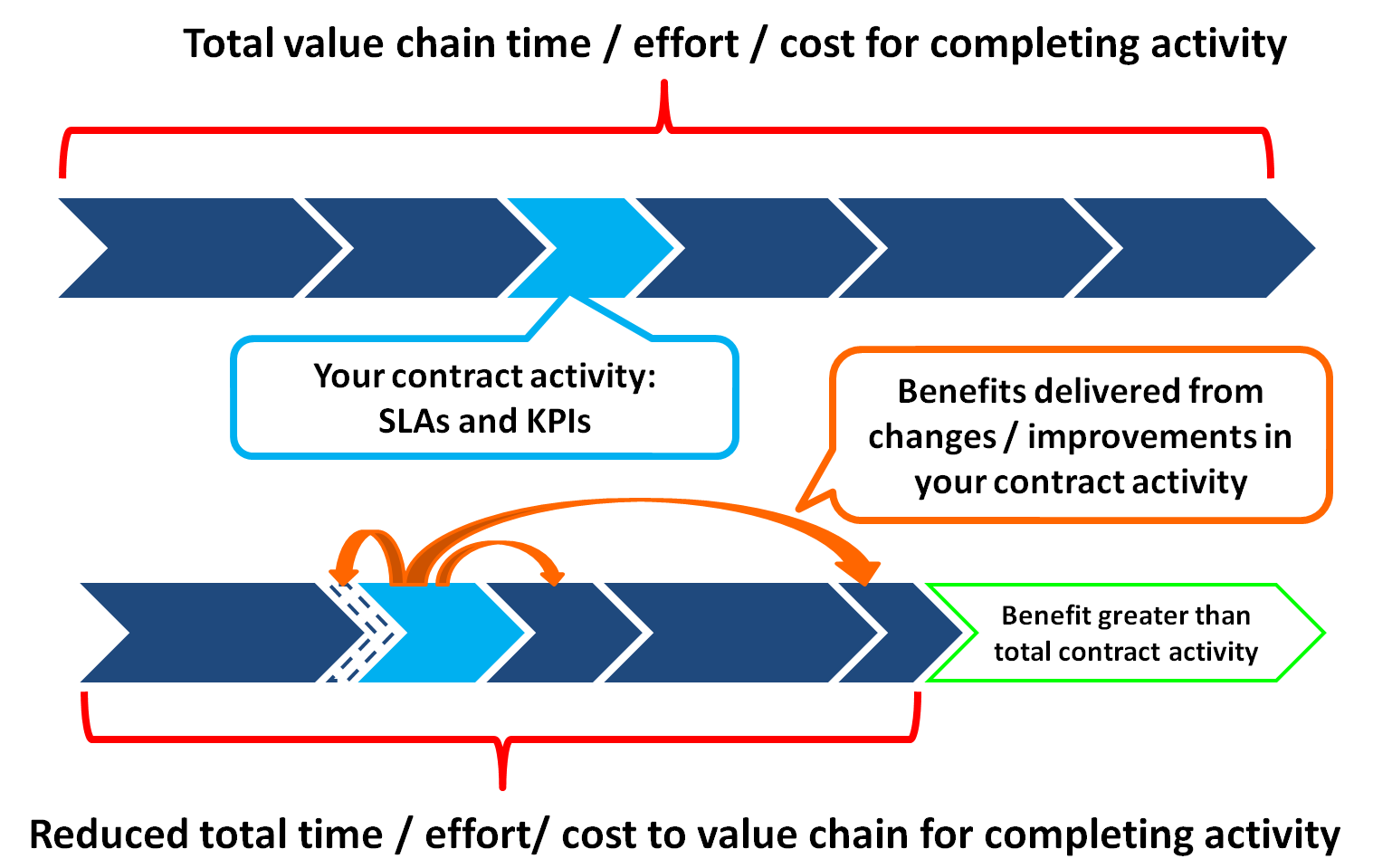
Most contracts deliver work which forms a part of a customer’s value chain – the set of activities that deliver the customer’s overall aims, goals or objectives, and deliver the products or services their organisation exists to provide.
Sometimes the contract activities are only a small part of that chain. Sometimes they cover several steps in the chain. But in the vast majority of cases there will be a range of other activities that form parts of the value chain before the work the contract does, after it, or that’s impacted by it.
If you can understand how your contract activities impact on the wider value chain you’re part of, and how the value chain delivers the customer’s strategic goals, you’ll get a clearer view of your place in the customer organisation.
And if you can generate ideas to help the customer reduce the costs, improve the speed, or increase the quality of other aspects of the value chain through changes in your contract delivery you’ll be able to deliver significant strategic benefits to your customer.
Benefits that can transform how the customer sees you and your relationship with them.
Steps to identify where to focus
The following steps will help you understand where to focus, and help you deliver changes to your contract delivering maximum strategic benefit to your customer:
- Understand your customer’s strategic goals. Step outside the immediate surroundings of your contract. Look at the most important goals your customer has as an organisation and the strategies and programmes they have in place to achieve these goals
- Analyse the value chain you’re part of. What happens before you get involved in the activities you’re contracted for? What happens afterwards to deliver one of these key customer goals? And what are the costs, resources, timings, outputs and measures of each stage?
- Use the analysis of customer’s wider aims and the full value chain you’re part of to generate ideas for how improvements or changes to your contract activities could create a benefit to another part of the value chain.
- Prioritise your ideas. Focus on those with the lowest cost but biggest impact for the customer
- Use (or create) a forum where you can discuss your ideas with a range of customer stakeholders. Get their input and support for specific ideas
- Implement initial ideas in conjunction with the other parts of the value chain that will see the benefits of your changes
- Measure the results to help you understand the improvement. And so you can use it as evidence with your customer now – and in the rebid.
Example:
A contract to deliver non emergency ambulance and transport services for a health authority to transport patients to appointments with doctors, or other healthcare providers was focused on the efficiency of this delivery. However a percentage of patients didn’t turn up for transport at the appointed time. Many would ring in to the contract call centre to cancel the transport on the day of their appointment. This caused some internal issues for the contract in lost journeys and reorganising journey planning.
But when the team looked at the wider value chain they realised that their inconvenience and cost caused by late cancellations was small compared to the lost and wasted time suffered by the healthcare providers the appointment was with. For instance a patient not attending for non emergency surgery without warning wasted the time of the surgeon, anaesthetist and supporting team, as well as the operating theatre.
By changing their process to check when a patient cancelled transport whether they would be attending their appointment. And then from the call centre contacting the health provider to ensure they also had notice of the patient not attending, the contractor could help save this waste. Giving the health provider the opportunity to call in another patient on the waiting list to attend on short notice – helping to reduce waiting times for a range of procedures.
The cost of the change to the contractor was minimal. The saving and other benefits to the customer (and their overall value chain) were significantly greater.
Summary
Look at the savings, or improvements you can help generate elsewhere in your customer’s value chain. And focus on those making a direct difference to the customer’s strategic goals.
The potential benefits to the customer could be very significant. In some cases even greater than the contribution of your own contract.
Delivering these focused but potentially radical improvements can change the customer’s view of you: from a contractor delivering a service which is somewhat isolated from their strategic goals, to a partner making a difference to their organisational aims.
It will help build better and deeper relationships with a range of more senior stakeholders in the business. And put you in a much stronger position by the rebid.
With a positive customer, a clearer understanding of the customer’s needs to base your solution on, and a range of evidence of how you’ve been proactive (and so will be in the next contract) in delivering real improvements and benefits to the customer.
Rebids aren’t just about the bid phase – by the time you get there, your chances of winning could already be decided.
See how Rebidding Solutions can help you put in place contract processes which improve your contract relationships, help you prepare for (or avoid) the rebid, and put you in the best posiiton to win before the rebid even starts. Contact us to schedule a call.


